University of Salford

A group of visitors wearing high-visibility safety vests and hard hats stand outside a multi-storey building under construction during a site tour. The building features exposed structural framing, scaffolding and partially completed exterior walls. Several attendees gather in front of the structure while others walk across the gravel construction site. Logos for engineering firms ARUP and Farrat are visible on some safety vests. The scene is set under a bright blue sky with large clouds, highlighting a modern construction and engineering project.

Optimising Vibration Isolation Systems in Building Design

Project outline This PhD project tackles one of the most pressing challenges in modern construction: how to optimize vibration isolation systems to minimize concrete usage, reduce environmental impact, and enhance urban living. By combining advanced Finite Element modelling, laboratory and field testing, and collaboration with industry leader, Farrat Isolevel, the research will deliver practical design recommendations and performance prediction tools. The […]

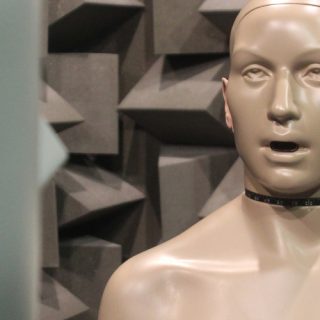
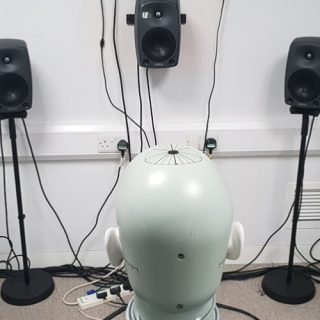
GRAS KEMAR Head and Torso Simulator designed for advanced acoustic testing in the Acoustics Lab, University of Salford

Personalised Auditory and Listener Preference Modelling for Headphone Audio Optimisation

Project outline This project aims to create a new generation of personalised headphone audio technology that adapts intelligently to an individual’s unique hearing profile and listener preferences. All users, whether they have hearing loss or not, want an effortless, high-fidelity listening experience. Project Partners You will be working closely with Sonos and using the latest […]

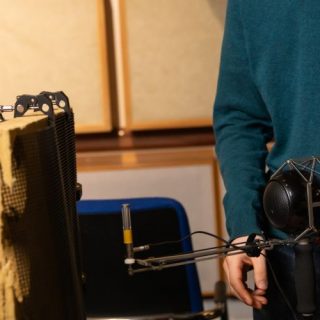
An acoustics research experiment is set up in a laboratory containing sound-absorbing wall panels. A person stands beside a microphone mounted on a stand and a test panel made of acoustic material. Additional specialised equipment, including a head-shaped acoustic measurement device, is visible on a table in the background. The scene shows a controlled environment for studying sound transmission, recording or acoustic performance.

Communication and Listening Effort for Blind and Partially Sighted People

Project outline Blind and partially sighted people are heavily reliant on gathering information via aural means. However, having reduced visual input increases listening effort. You will either investigate the cocktail party effect for people with sight loss or reducing listening effort for screen readers at high word rates.  Project Partners This project is based at the University of Salford with funding from the Royal National Institute […]

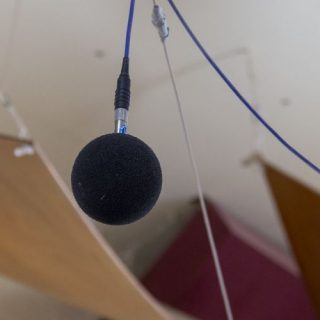
A suspended measurement microphone hangs from cables beneath a ceiling fitted with curved wooden acoustic panels. The microphone is positioned among tensioned wires and acoustic treatment elements designed to control sound within the space. The background is softly out of focus, highlighting the microphone and the architectural acoustics features of the room.

Improving the Accuracy of Transfer Path Analysis for Prototyping Vehicles

Project outline Predicting the noise and vibration from complex structures like cars is a common challenge in engineering design. Transfer Path Analysis (TPA) can be used for this NVH work, speeding prototyping and reducing design costs. In TPA, you break down systems into key components, coupling together models of vibration sources, such as electric motors, to passive receiver structures, like a car body. This PhD is about improving measurements that feed into TPA, to increase the accuracy of the noise and vibration predictions. Improving prediction accuracy, […]

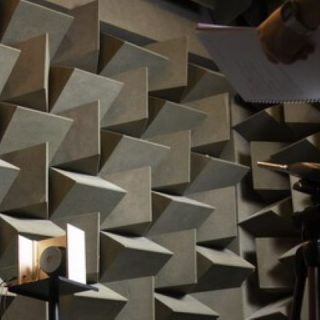
An acoustics experiment takes place inside an anechoic chamber lined with large wedge-shaped sound-absorbing panels. A loudspeaker mounted on a stand faces measurement equipment positioned on a tripod, while a researcher stands nearby holding a notebook. The chamber’s geometric foam wedges cover the walls to minimise sound reflections, creating a controlled environment for acoustic testing and measurement.

Improving Noise and Vibration in Cars

Project outline Option A – Advanced acoustic metamaterials for automotive application The sound a car makes is extremely important for customer satisfaction. Acoustic materials are one of the most common ways of treating unwanted sounds in the vehicle cabin. Metamaterials have become a hot topic in acoustics research and offer the possibility of creating more sustainable acoustic […]

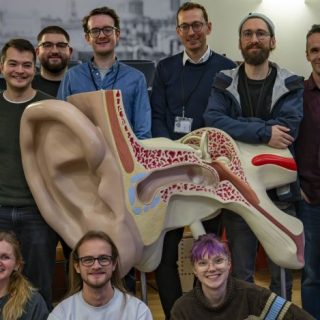
Cohort 1 of the EPSRC Sustainable Sound Futures CDT gathered for a group photo indoors around a large anatomical ear model used for sound and hearing research.

Psychoacoustic Modelling for Complex Soundscapes

Project outline This research addresses a critical gap in the evaluation of environmental and technical sounds by developing and validating psychoacoustic models for sharpness and impulsiveness within the Sottek Hearing Model (SHM) framework, then optimising these models for real-world complex soundscapes rather than idealised laboratory conditions. Current sound evaluation methods rely heavily on basic frequency-weighted […]

Cohort 1 of the EPSRC Sustainable Sound Futures CDT gathered for a group photo indoors around a large anatomical ear model used for sound and hearing research.

Psychoacoustic Assessment and Machine Listening-Based Modelling of Novel Noise Source Perception in Complex Soundscapes

Project outline The rollout of low-carbon technologies is introducing unfamiliar sounds into everyday environments: These technologies bring clear financial and environmental benefits, yet their acoustic footprints are often quite different from the noise sources they replace. Tonal, fluctuating, high-pitched, and sometimes persistent in character – such sounds can alter how people perceive the quality and […]

Cohort 1 of the EPSRC Sustainable Sound Futures CDT gathered for a group photo indoors around a large anatomical ear model used for sound and hearing research.

Physics-informed Machine Inference for Vibro-acoustics

Project outline Large numerical simulations dominate marine and aerospace industries when performing structural analysis on engineering platforms. These models are computationally intensive, and model updating often requires complete re-simulation. To enable practical real-time sensing applications for noise and vibration, sufficient sensor coverage is needed to acquire the data which characterises the dynamical behaviour for quantifying […]

Cohort 1 of the EPSRC Sustainable Sound Futures CDT gathered for a group photo indoors around a large anatomical ear model used for sound and hearing research.

Physics-informed Machine Learning for Acoustic Simulations

Project outline Numerical methods for acoustic simulations are well established, but scale poorly to high frequencies and large domains. Important applications include simulation of outdoor noise propagation and room acoustics. Physics-informed machine learning is a new and rapidly developing field that has shown promising early results in other physical sciences, and offers significant potential for […]

Cohort 1 of the EPSRC Sustainable Sound Futures CDT gathered for a group photo indoors around a large anatomical ear model used for sound and hearing research.

Optimising Air Source Heat Pump Planning and Placement to Minimise Community Noise Impact

Project outline Air source heat pumps (ASHPs) offer a significant opportunity to decarbonise home heating. However, the increasing rate of installations at homes across the UK and Europe may lead to a rise in community noise, impacting public health and wellbeing, and potentially hindering the adoption of heat pumps. Current standards for assessing noise from […]