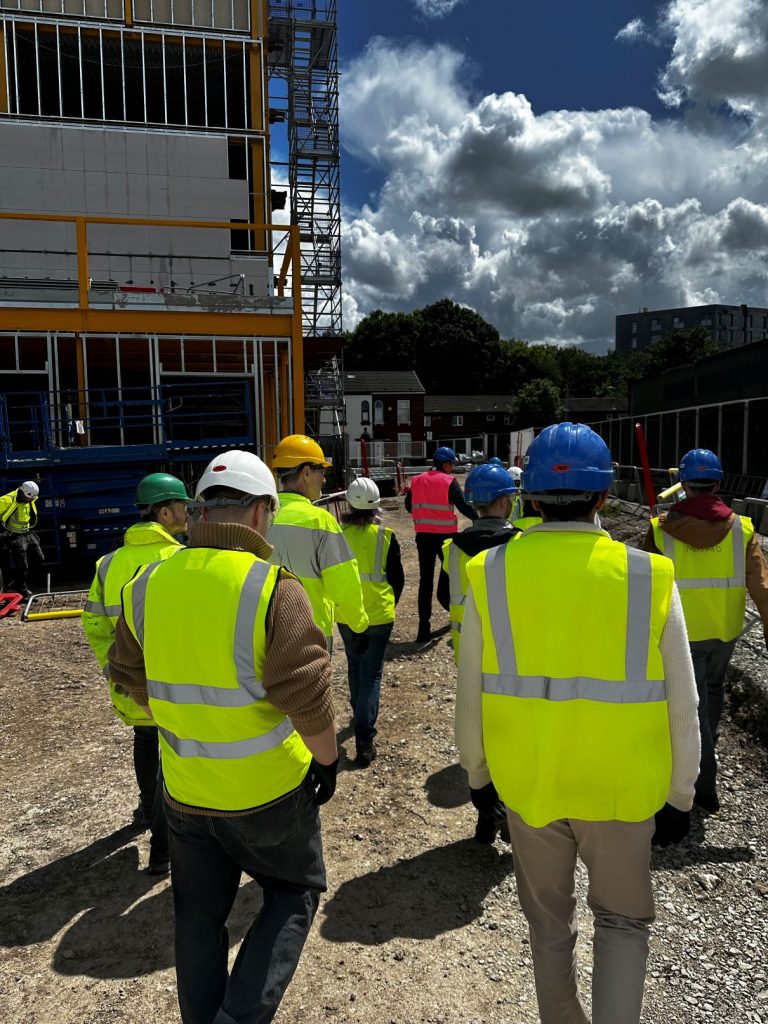
Students attending the 2026 Summer School recently gained valuable insight into the future of acoustic engineering, combining expert-led talks with an exclusive behind-the-scenes tour of the university’s new state-of-the-art Acoustics Building.
The visit formed part of the wider summer school programme designed to connect academic learning with real-world applications. Students attended specialist talks from Sam Peckham (Arup) and Ryan Arbabi (Farrat), who shared expertise on building design and acoustic isolation, highlighting how sound and vibration control are integrated into modern construction projects.
A Landmark Facility for Acoustic Research
The highlight of the visit was a guided tour of the University’s new Acoustics Building, part of the wider Crescent Innovation development. The facility is set to become a hub for world-class research, designed to support experiments requiring exceptionally controlled acoustic environments.
Farrat, a leading engineering company specialising in vibration control, has played a significant role in the project. Working alongside Morgan Sindall Construction and the broader design team from an early stage, Farrat contributed to the development and specification of key acoustic isolation elements.
These include advanced acoustic bearings, designed to prevent unwanted vibration and noise from entering sensitive research spaces—an essential requirement for experiments where even minimal disturbances can compromise results.
Engineering Ultra-Controlled Environments
The work undertaken on the building reflects the highly technical challenges involved in acoustic research infrastructure. Through detailed workshops and technical reviews, Farrat and its partners ensured that the building meets stringent performance standards.
Such precision engineering is vital for creating ultra-controlled environments, where researchers can conduct experiments free from external interference. These spaces enable cutting-edge studies in acoustics, psychoacoustics, and vibration, supporting innovation across multiple disciplines.
A First-Hand Learning Experience
Students were given a detailed walkthrough by Ryan Arbabi (Farrat’s Major Project Director), who explained the purpose and impact of Farrat’s technologies. The tour provided a rare opportunity to see how theoretical principles are translated into real-world engineering solutions, reinforcing the importance of collaboration between academia and industry.
Collaboration at the Core
The project highlights the value of close collaboration between universities, engineers, and construction teams in delivering complex infrastructure. By working together from the earliest design stages, partners were able to ensure that acoustic performance remained a central focus throughout the build.
For students, the experience offered not only technical insight but also a broader understanding of how multidisciplinary teamwork drives innovation in the built environment.
Inspiring the Next Generation
As the new Acoustics Building nears completion, initiatives like this visit underline the University of Salford’s commitment to hands-on, industry-connected learning. By engaging directly with professionals and exploring live construction projects, the CDT students gain the knowledge and inspiration needed to shape the future of acoustic engineering.