Projects

Explore Sustainable Sound Futures PhD projects within our Centre for Doctoral Training, bringing together researchers from the Universities of Salford, Bristol, Sheffield, and Southampton. Combining expertise across science, engineering, design, and the social sciences, our projects harness the power of sound to create meaningful real-world impact. All projects are funded by EPSRC and our industry partners.

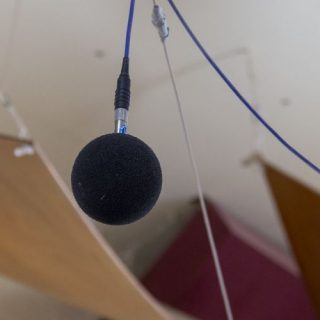
A suspended measurement microphone hangs from cables beneath a ceiling fitted with curved wooden acoustic panels. The microphone is positioned among tensioned wires and acoustic treatment elements designed to control sound within the space. The background is softly out of focus, highlighting the microphone and the architectural acoustics features of the room.

Improving the Accuracy of Transfer Path Analysis for Prototyping Vehicles

Project outline Predicting the noise and vibration from complex structures like cars is a common challenge in engineering design. Transfer Path Analysis (TPA) can be used for this NVH work, speeding prototyping and reducing design costs. In TPA, you break down systems into key components, coupling together models of vibration sources, such as electric motors, to passive receiver structures, like a car body. This PhD is about improving measurements that feed into TPA, to increase the accuracy of the noise and vibration predictions. Improving prediction accuracy, […]

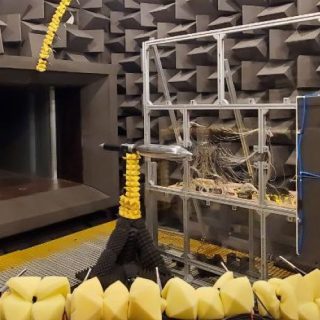
An acoustics experiment takes place inside an anechoic chamber lined with large wedge-shaped sound-absorbing panels. A loudspeaker mounted on a stand faces measurement equipment positioned on a tripod, while a researcher stands nearby holding a notebook. The chamber’s geometric foam wedges cover the walls to minimise sound reflections, creating a controlled environment for acoustic testing and measurement.

Improving Noise and Vibration in Cars

Project outline Option A – Advanced acoustic metamaterials for automotive application The sound a car makes is extremely important for customer satisfaction. Acoustic materials are one of the most common ways of treating unwanted sounds in the vehicle cabin. Metamaterials have become a hot topic in acoustics research and offer the possibility of creating more sustainable acoustic […]

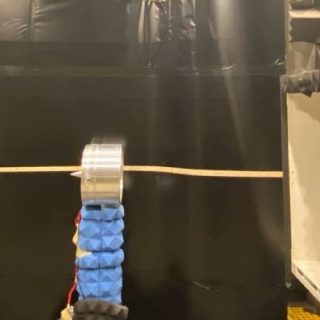
Acoustic test chamber with sound-absorbing foam walls, central experimental apparatus, and enclosed measurement equipment.

Low-Frequency Acoustic Metamaterials for Aircraft Noise Reduction   

Project outline Aircraft noise remains a major environmental challenge as the aviation industry moves toward quieter and more sustainable propulsion systems. Low-frequency noise, produced by jet engines and fans, is particularly difficult to suppress using conventional acoustic liners due to its long wavelengths and high energy content. This PhD project will explore the use of […]

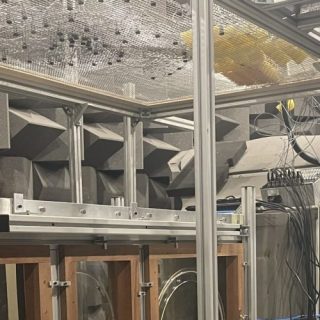
Acoustic testing chamber with sound-absorbing foam walls, measurement equipment, and cable-covered structures.

Vertiport Design and Noise Management for Urban Air Mobility  

Project outline As electric vertical take-off and landing (eVTOL) aircraft move closer to widespread adoption in future cities, the design of vertiports which are dedicated take-off and landing hubs, has become increasingly important in ensuring safe, efficient, and publicly acceptable urban air mobility systems. Noise is one of the key challenges facing this transition. The […]

Instrumented model aircraft in a test rig, surrounded by sensors, tubing, and acoustic measurement equipment.

Turbulent Flow Induced Noise Prediction and Modelling  

Project outline This PhD project takes on one of the most fascinating challenges in modern aerospace engineering: understanding how turbulent airflows create noise and vibration when they interact with aircraft surfaces. These turbulent pressure fluctuations are key to designing the next generation aircraft, ship and other transport systems. Project Partners Working with leading researchers at […]

High-Fidelity CFD and Aeroacoustics Investigation of Turbulent Flow-Induced Noise From Aircraft Landing Gear 

Project outline The noise generated by complex aircraft components, such as landing gear systems, presents a significant scientific and engineering challenge. Reducing this noise is crucial as aircraft manufacturers strive to meet stringent environmental regulations and minimise the acoustic footprint of modern aircraft. Accurately predicting noise from such complex geometries depends on a detailed understanding […]

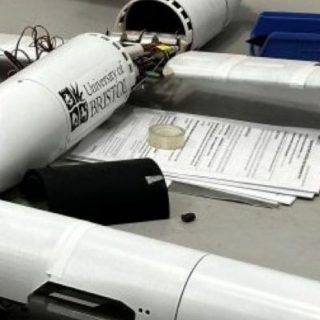
Small fixed-wing unmanned aircraft prototype on a workbench, with exposed internal components and detached fuselage section.

Experimental Investigation of Flow-Induced Noise from Aircraft Landing Gear

Project outline Aircraft noise remains a major environmental and public health concern, with landing gear systems representing a significant contributor to the overall noise signature during approach and landing. Understanding the complex mechanisms behind landing gear noise generation requires detailed knowledge of the turbulent flow development around these intricate geometries. The project will combine experimental […]

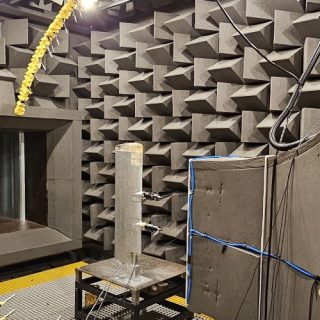
A specialised acoustics testing chamber is lined with large wedge-shaped sound-absorbing foam panels on the walls and ceiling. In the centre of the room, a circular array of microphones mounted on a large ring-shaped frame surrounds experimental equipment positioned on a grated floor. Additional sensors, cables and acoustic measurement devices are connected to a test setup near a large opening in the chamber wall. The facility is designed for precision acoustic measurements in a controlled, reflection-free environment.

Propeller and Rotor Broadband Noise

Project outline As urban air mobility continues to develop, electric vertical take-off and landing vehicles (eVTOLs), drones, and air taxis are expected to transform the way people and goods move within and between cities. These emerging technologies promise cleaner, more efficient transport, but their success depends on achieving low noise levels that make them acceptable […]

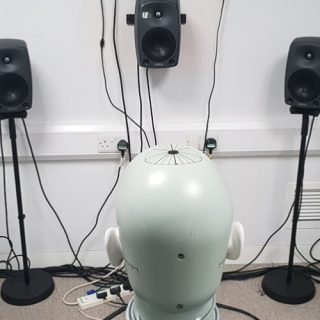
Cohort 1 of the EPSRC Sustainable Sound Futures CDT gathered for a group photo indoors around a large anatomical ear model used for sound and hearing research.

Psychoacoustic Modelling for Complex Soundscapes

Project outline This research addresses a critical gap in the evaluation of environmental and technical sounds by developing and validating psychoacoustic models for sharpness and impulsiveness within the Sottek Hearing Model (SHM) framework, then optimising these models for real-world complex soundscapes rather than idealised laboratory conditions. Current sound evaluation methods rely heavily on basic frequency-weighted […]

Cohort 1 of the EPSRC Sustainable Sound Futures CDT gathered for a group photo indoors around a large anatomical ear model used for sound and hearing research.

Psychoacoustic Assessment and Machine Listening-Based Modelling of Novel Noise Source Perception in Complex Soundscapes

Project outline The rollout of low-carbon technologies is introducing unfamiliar sounds into everyday environments: These technologies bring clear financial and environmental benefits, yet their acoustic footprints are often quite different from the noise sources they replace. Tonal, fluctuating, high-pitched, and sometimes persistent in character – such sounds can alter how people perceive the quality and […]